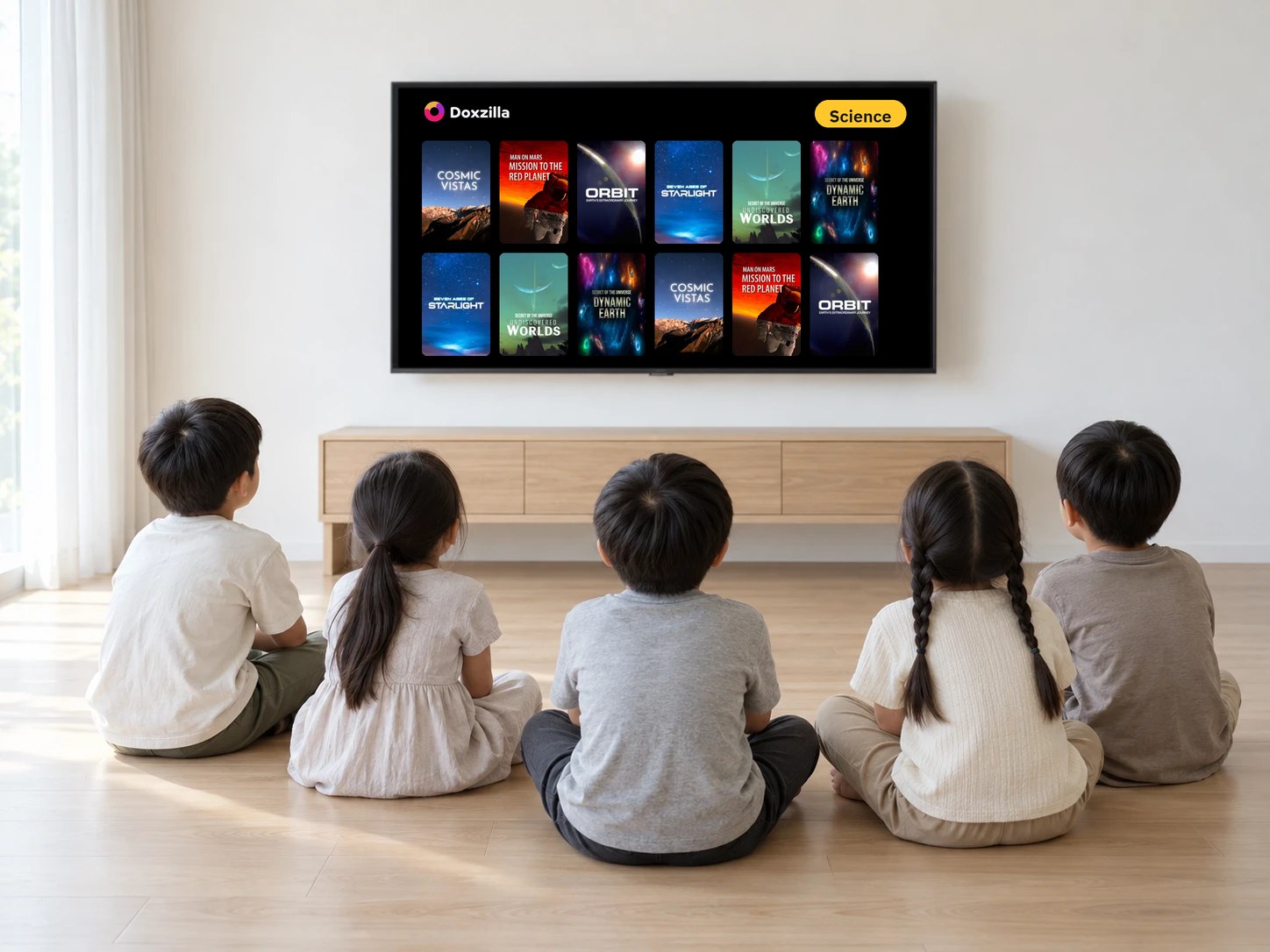
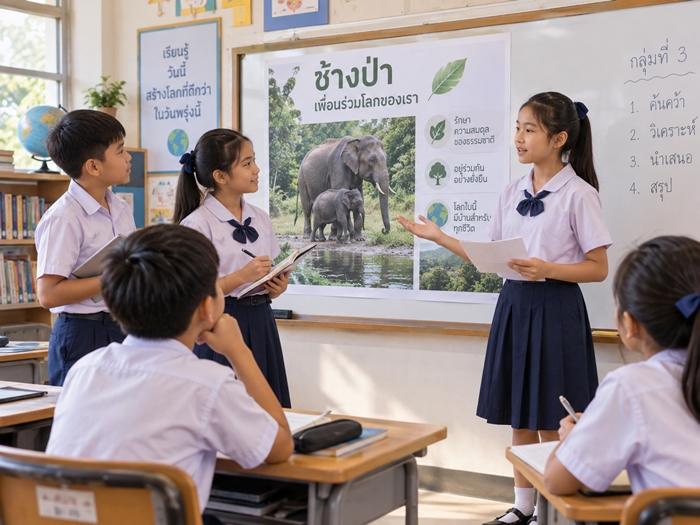
Thailand's future does not have to wait. It starts in class tomorrow, with one film and one question.
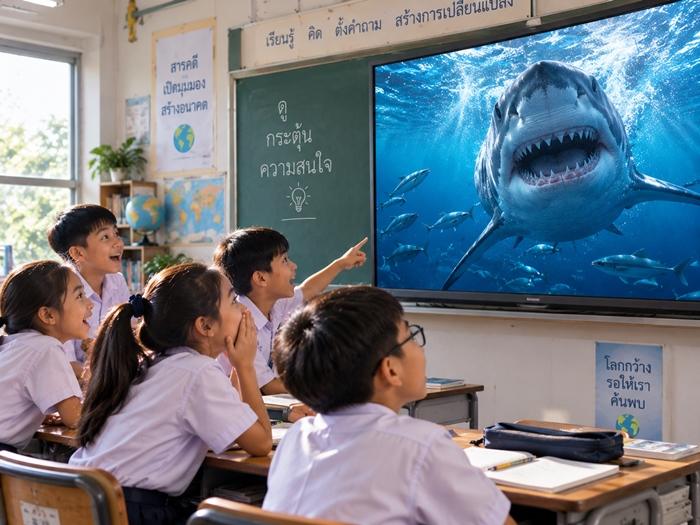
The whole class watches the same film. Then children think for themselves, talk with a friend, take turns to tell it and sum it up in their own way. There are no answers for you to prepare and no extra lesson to teach. Read one question aloud, then listen.
The five steps take about 20 minutes after the film. The last step puts the screen down and says it out loud, so children leave with something to tell. Twenty minutes is a guide. Your own timing wins.
1
Watch
Choose a film that suits the age group and play it to the whole class. No talking while it plays. Each child keeps what they saw for themselves.
2
Think
The film ends. Read one question aloud. Everyone thinks in silence. There is no right answer and nothing to mark.
3
Talk
Children turn to the person next to them, or form groups of about five, and take turns hearing a view that is not their own. You walk around and listen to a few groups. You do not have to hear them all and you do not have to take notes.
4
Present
Every child is invited to take a turn to lead and to tell, not only the confident ones, and no one is made to. Anyone who would rather draw or write can do that instead.
5
Reflect
Each child sums up what they took from it in their own way. Speak, draw or write one line in a notebook. No one marks it. No homework.
IllustrationIllustration
Short on time? One question, three minutes.
When the film ends, read one question aloud, once. Children think in silence, then turn to the person next to them and take about half a minute each. You listen in on a few pairs. Three minutes at most. Ready when you are.
Use it like this all year if you like. You know your class best.
Start with the age of the class
3 to 5
Sit in one big circle and ask the whole class one question. Listen to whoever wants to tell. Children who do not want to speak can draw.
6 to 8
Start with pairs. When the class is used to it, after about a month, move to groups of three.
9 to 14
Groups of about five work. Children this age can wait for a friend to finish. Everyone is invited to take a turn. No one has to.
15 to 18
Let students choose. They can join a group, talk in pairs or write alone in a notebook.
The same rules at every age. Tell and listen in order to learn. No marks. No competing. No groups by ability. Change group members every month.
Another way in for every child
Drawing, a voice note, a gesture, or the language a child speaks at home. Any of these counts as an answer. You do not need to tell us anything about a child. No paperwork.
Teacher's Guide
Free to read. It shows you how to read the question, how to listen, how to make groups and how to adjust for age. It works with any film. Every film set comes with an activity sheet.
My child is more curious now. They come and ask me about what they watched.
We got family time back. Parent and child sit and talk again.
Doxzilla is recognised by UNESCO for its educational content. Next Step Thailand is on the list of UNESCO Bangkok partners (Snapshots 2025).
Every child in the region gets the same access
For schools, school districts and regional education authorities.
Fair access means every child in a region can watch, talk and be heard, in every school and every year, not only in the schools that can afford it first. Two things can be bought, separately.
Learning mode for students
Priced per student per year. Each student gets their own account and each teacher gets the teacher's tools.
Regional youth media service
Priced per region per year. Our team goes out and works with children in the region's schools.
Buy either one, or both.
Price
We give a clear price per student per year, with the supporting documents your organization needs. Get in touch and we will send an itemised quote you can check line by line.
Want the whole school to try it?
Schools and organizations: message us on LINE @doxzilla and tell us the school, the province and roughly how many students. We reply within 2 working days.